The Fallen Primes of Tohu
Elon Litman
December 07, 2025
Filed under “Random Matrix Theory”

T he setting was a void. Not darkness, or not only darkness: an emptiness that seemed to precede the possibility of light. It was set very far from the present, though I couldn't tell in which direction. Within the dream this distinction carried no weight. Everyone I'd ever known was already gone, or hadn't happened yet. I recall deciding I should wave goodbye to them; a gesture that even at the time struck me as formally correct but meaningless. The faux-darkness came up like water, though in a true void there should be no rising, no direction. There was just a number. The number was large. I will not attempt to reproduce it here exactly because part of the dream's texture was that the number could not be fully apprehended, only gestured toward. It was rendered on something like a screen, or perhaps seared directly into whatever remains of visual experience when you subtract the visual cortex, the eyes, the body, the universe that held the body. The number was very large: $$100,000,000,000,000,000,000,000,000,000,000,000,000,000,000,000,000,000,000,000,000,000,000,000,000,000,000,000,000,000,000,000,000,000,000,000,000,000,000,000,000,000,000,000,000,000,000,000,000,000,000,000,000,000,000,000,000,000,000,000,000,000,000,000,000,000,000,000,000,000,000,000,000,000,000,000,000,000,000,000,000,000,000,000,000,000,000,000,000,000,000,000,000,000,000,000$$ Or perhaps it was $10$ to the power of that number. Or something worse.
I was seven, maybe eight. My fate was to count from \(1\) to this number. One, two, three, four. I understood that I would be counting forever, that the task was not merely difficult but impossible, and that this impossibility did not exempt me from the obligation.
I find that the description never transmits the affect. It really doesn't sound so bad. Nothing happens.
It contains no monsters, no humiliation, no teeth falling out.The psychological literature calls this apeirophobia: fear of infinity. See Becker's The Denial of Death (1973) for a psychoanalytic treatment of how confrontation with the infinite triggers existential terror.
Incredibly, I have since encountered multiple threads where strangers report some murmurous variation of this identical dream: counting to infinity, geometric nightmares, abstract fever-panics, the sense of being conscripted by the universe. I don't know what to make of that, whether it reveals something about numbers, or about the structure of human anxiety, or about nothing in particular.
Some Background on Numbers
We generally treat numbers as markers of quantity. They measure size or duration; they answer the question how many. In this mode, every integer is generated by the simple repetition of the unit.
But the integers also possess an internal architecture. The Fundamental Theorem of Arithmetic states that every number greater than \(1\) is formed by a unique product of irreducible factors. This theorem shifts the perspective from addition to division. It reveals that numbers are not merely sums but composites, built from a specific set of foundational integers.
These foundational integers are the primes.
Here is the definition of a prime number: a positive integer greater than \(1\) that cannot be expressed as a product of two smaller positive integers.Euclid proved there are infinitely many primes around 300 BCE in Book IX, Proposition 20 of the Elements. His proof by contradiction remains one of the most elegant arguments in all of mathematics. The primes are \(2\), \(3\), \(5\), \(7\), \(11\), \(13\), \(17\), \(19\), \(23\), \(29\), \(31\)…
And here is the first hint that something is strange: try to predict the next one.
After \(31\) comes… \(37\). Then \(41\), \(43\), \(47\), \(53\), \(59\), \(61\), \(67\), \(71\), \(73\), \(79\), \(83\), \(89\), \(97\)…
The gaps are \(6\), \(4\), \(2\), \(4\), \(6\), \(6\), \(2\), \(6\), \(4\), \(2\), \(6\), \(4\), \(6\), \(8\)… There's no pattern. Or rather, there's clearly something going on, the gaps are never \(1\) after the first prime, they're always even after \(2\), but it's not the kind of pattern that lets you just write down a formula.
The primes are not random; they're completely deterministic. Given any integer, you can check in finite time whether it's prime. Yet the sequence they generate, by every statistical test we can throw at it, looks like noise.
Thus, mathematicians gave up on predicting individual primes and started asking statistical questions instead. Not where is the next prime? but how many primes are there up to \(x\)?
Call this count \(\pi(x)\). Gauss, when he was fifteen years old, noticed something remarkable: the density of primes near \(x\) seems to be roughly \(1/\ln x\).Gauss described this observation in an 1849 letter to the astronomer Encke, recalling work from his youth. He had been studying tables of primes compiled by Johann Lambert and others, counting primes by hand through the thousands. A century later, this transmogrified into the Prime Number Theorem:Proved independently by Jacques Hadamard and Charles Jean de la Vallée Poussin in 1896. Both proofs required showing that \(\zeta(s)\) has no zeros on the line \(\Re(s) = 1\) (foreshadowing RH).
The Prime Number Theorem establishes the asymptotic limit. It describes the smooth, continuous curve that best approximates the discrete step-function of the prime count. It says nothing of the deviation from this average. The discrepancy between the predicted density and the actual count is not random noise. It consists of the oscillatory terms that determine the precise placement of the primes.
The Error Term
Define the error: \(E(x) = \pi(x) - \text{Li}(x)\).
The error is not random noise. It exhibits a systematic oscillatory character, implying that the deviation from the average is composed of distinct periodic elements. The fluctuations follow a coherent interference pattern, some hidden signal modulating the distribution of primes.
Bernhard Riemann figured out what that signal is in 1859."Über die Anzahl der Primzahlen unter einer gegebenen Grösse" (On the Number of Primes Less Than a Given Magnitude). This eight-page paper, Riemann's only work in number theory, introduced the analytic continuation of \(\zeta(s)\), stated the hypothesis, and sketched proof ideas that would take mathematicians decades to make rigorous. Harold Edwards' Riemann's Zeta Function (1974) remains the definitive exposition. He showed that the error term is controlled by the zeros of a certain complex function (the function now named after him).
The Euler Product
Consider the sum:
We established that every positive integer has a unique prime factorization. When you sum over all \(n\), you're summing over all possible combinations of prime powers. This is the same as multiplying together, for each prime \(p\), the geometric series
Therefore:
This is the Euler product formula.Euler derived this identity in 1737, originally for real \(s > 1\). It was his proof that there are infinitely many primes; if there were finitely many, the product would be finite, but the sum diverges at \(s = 1\). See Chapter 1 of Hardy and Wright's An Introduction to the Theory of Numbers (1938). This identity equates the summation over the natural numbers with the product over the primes. It transforms the arithmetic property of unique factorization into an analytic relationship, permitting the study of discrete number theory using continuous methods.
Riemann's insight was to extend this function to complex numbers \(s = \sigma + it\), and to study its zeros.
Where the Zeta Function Vanishes
The zeta function, extended to the whole complex plane, has trivial zeros at the negative even integers. The interesting zeros, the non-trivial zeros, all lie in the critical strip where \(0 < \Re(s) < 1\). Riemann calculated a few of them and noticed they all had real part exactly \(1/2\). He conjectured that all non-trivial zeros have this property.
This is the Riemann Hypothesis: every non-trivial zero of \(\zeta(s)\) has the form \(\rho = \frac{1}{2} + i\gamma\), where \(\gamma\) is a real number.One of the seven Clay Mathematics Institute Millennium Prize Problems, with a \(1\) million dollar bounty. As of 2026, over \(10\) trillion zeros have been computed, all on the critical line. It's been 165 years and nobody has been able to prove or disprove it.
Why does this matter? Because Riemann also proved an explicit formula relating the primes to these zeros:
where \(\psi(x)\) is a weighted prime-counting function, and the sum runs over all non-trivial zeros.
Each zero contributes a term. If \(\rho = \frac{1}{2} + i\gamma\), then \(x^\rho = x^{1/2} e^{i\gamma \ln x}\). This is a wave: amplitude proportional to \(\sqrt{x}\), oscillating with frequency \(\gamma\) as \(x\) varies.
The distribution of primes is literally a superposition of waves. The frequencies are determined by the imaginary parts of the zeta zeros. The Riemann Hypothesis is the statement that all these frequencies are real: that the music of the primes is played on the critical line.Marcus du Sautoy's The Music of the Primes (2003) takes its title from this metaphor. The explicit formula can be understood as a kind of Fourier decomposition, with each zero contributing an oscillatory term.
Nuclei, Zeta Zeroes, & Quantum Chaos
A heavy nucleus like uranium-238 contains \(92\) protons and \(146\) neutrons, all interacting through forces that remain, for practical purposes, impossible to compute from first principles. The system's permissible energy levels are determined by its Hamiltonian, a mathematical operator of such complexity that no one can write it down exactly, let alone solve it.
Eugene Wigner's insight was to recognize that this intractability might itself be useful.Wigner introduced random matrix models for nuclear physics in a series of papers beginning with "Characteristic Vectors of Bordered Matrices with Infinite Dimensions" (1955). For a historical account, see Mehta's Random Matrices (3rd ed., 2004), the definitive mathematical reference. His proposal, counterintuitive prima facie, was to abandon the specific Hamiltonian entirely and treat it as random: to study the statistical behavior of ensembles of operators satisfying the same symmetry constraints. The intuition: a Hamiltonian of sufficient complexity becomes, in its spectral statistics, indistinguishable from a random matrix drawn from an appropriately constrained distribution. The microscopic details wash out and only the symmetries matter.
The most tractable such ensemble is the Gaussian Unitary Ensemble (GUE): the space of \(N \times N\) Hermitian matrices with independently distributed Gaussian entries. The spectral statistics of GUE matrices are now thoroughly understood. Most important for our purposes is the phenomenon of level repulsion: eigenvalues of random Hermitian matrices exhibit a marked tendency to avoid one another. The probability density for finding two eigenvalues separated by a small gap \(s\) goes as \(s^2\) for small \(s\), a quadratic vanishing that differs sharply from what you'd get from independently scattered points on a line.
The connection to number theory emerged through accident.Montgomery published his pair correlation conjecture in "The Pair Correlation of Zeros of the Zeta Function" (1973), Proc. Symp. Pure Math. 24, pp. 181–193. The paper includes a charming account of the tea with Dyson. In 1972, Hugh Montgomery had been studying the pair correlation of Riemann zeta zeros (i.e. the statistical distribution of spacings between consecutive zeros on the critical line) assuming the Riemann Hypothesis holds. His result:
where \(u\) measures the normalized separation between zeros. The function vanishes at \(u = 0\). The zeros repel.
During a tea at the Institute for Advanced Study, Montgomery mentioned this formula to Freeman Dyson.Dyson had classified the random matrix ensembles by symmetry in his 1962 "Threefold Way" paper. The GUE, GOE (orthogonal), and GSE (symplectic) correspond to systems with different time-reversal properties. That zeta zeros match GUE rather than GOE suggests the "Riemann operator," if it exists, breaks time-reversal symmetry. Dyson recognized it immediately. The expression was the pair correlation function for GUE eigenvalues. Exactly.
The situation merits careful statement. The zeta zeros are deterministic objects, fixed for all time by the definition of \(\zeta(s)\). Given sufficient computational resources, one can calculate any finite subset of them to arbitrary precision; they contain no randomness whatsoever. GUE eigenvalues, in contrast, are stochastic by construction. That two such different kinds of objects should exhibit identical statistical behavior is, to put it conservatively, perplexing.
Andrew Odlyzko's subsequent numerical work made the case overwhelming.See "The \(10^{20}\)-th Zero of the Riemann Zeta Function and 175 Million of Its Neighbors" (1989), and subsequent computations extending to \(10^{13}\) zeros. Odlyzko's data is publicly available at his website and has been used by countless researchers since. Computing more than \(10^{10}\) zeta zeros far from the origin, where asymptotic behavior dominates, Odlyzko compared their spacing distribution against GUE predictions across multiple statistical measures. The agreement held to within the limits of numerical precision. Whatever mechanism underlies this correspondence, it is not a small-sample artifact or a low-order approximation. It persists, and persists exactly, as far into the critical strip as computation can probe.
There is an old conjecture, ostensibly attributed to Hilbert and Pólya though the historical record is unclear,Neither Hilbert nor Pólya appears to have written the conjecture down. We have only a terminus post quem (spectral theory had to exist) and a terminus ante quem (Hilbert's death in 1943). Odlyzko reports that Pólya told him in the 1980s that the idea came from conversations with Hilbert, but no primary source survives. See the historical discussion in Conrey's "The Riemann Hypothesis" (2003), Notices of the AMS. that the zeta zeros are eigenvalues. Not of a random matrix, but of some specific self-adjoint operator. If such a Riemann operator could be constructed and proven Hermitian, the Riemann Hypothesis would follow immediately: Hermitian operators have real eigenvalues, so if the eigenvalues are the imaginary parts \(\gamma_n\) of the zeta zeros, those imaginary parts must be real, which means all zeros have real part exactly \(\tfrac{1}{2}\). The conjecture predates quantum mechanics itself: Hilbert and Pólya were groping toward a spectral theory of primes before Heisenberg and Schrödinger had given us the means to make such speculations precise.
The random matrix correspondence tells us what this operator should look like: it must describe a quantum system that is chaotic and breaks time-reversal symmetry. The question is whether such an operator actually exists.
Michael Berry and Jonathan Keating, in the 1990s, further noticed a structural parallel between Riemann's explicit formula and the Gutzwiller trace formula from quantum chaos.Gutzwiller developed the trace formula in the 1970s; see his monograph Chaos in Classical and Quantum Mechanics (1990). The formula is a semiclassical approximation relating a sum over quantum eigenvalues to a sum over classical periodic orbits, each weighted by its stability properties. The Gutzwiller formula relates the periodic orbits of a classical system to the quantum energy levels of its quantization. Berry and Keating proposed an exact correspondence:See Berry and Keating, "The Riemann Zeros and Eigenvalue Asymptotics" (1999), SIAM Review 41(2), pp. 236–266, for a comprehensive exposition of their program. Also relevant: Berry, "Riemann's Zeta Function: A Model for Quantum Chaos?" (1986), Lecture Notes in Physics 263.
The zeta zeros are the quantum eigenvalues of some chaotic Hamiltonian. The prime numbers, specifically, their logarithms, are the periods of classical periodic orbits. Thus, the arithmetic we perceive is a kind of classical limit of something more fundamental.
The arrow of induction in the physical sciences usually points from physics to mathematics: we invent new math to explain physical phenomena. Riemannian geometry was a curiosity used by Hermann von Helmholtz to measure the distance between different shades of red and green until Einstein needed it for gravity. Group theory eventually became the façon de parler of particle physics. The zeros represent a non-trivial upending of the epistemological order. Rather than mathematics serving as a descriptive tool for reality, a platonic pattern arising from the abstract constraints of number theory appears to prescribe the existence of a physical system.
Berry and Keating's candidate Hamiltonian was \(H = xp\), or rather its symmetrized quantum version \(H = \tfrac{1}{2}(xp + px)\). The classical dynamics are simple: the equations of motion give \(\dot{x} = x\) and \(\dot{p} = -p\), so trajectories are hyperbolas in phase space. There are no periodic orbits in the usual sense—the particle escapes to infinity. But Berry and Keating argued that if you impose certain boundary conditions, identifying points related by scaling, you can create effective periodicity with periods equal to the logarithms of integers.
The proposal possesses great conceptual appeal, but its dynamical components have yet to be rigorously formulated. The operator \(xp\) is not self-adjoint on any standard Hilbert space; its spectrum is not well-defined without additional structure. The boundary conditions needed to produce the zeta zeros seem to require knowing the answer in advance.Alain Connes has developed an elaborate framework in noncommutative geometry that, he argues, provides the natural setting for the Riemann operator. See "Trace Formula in Noncommutative Geometry and the Zeros of the Riemann Zeta Function" (1999), Selecta Math. 5, pp. 29–106.
The Inverse-Dyson Flow
When I first learned about the GUE correspondence, my instinct as an AI researcher was predictable:
Cool, let's train a diffusion model on it.
This turns out to be, on reflection, a rather stupid idea. We don't need to hallucinate new zeros; Riemann gave us an exact formula in 1859. What we actually want is a tool that measures how far the arithmetic reality deviates from the random matrix ideal, whether this deviation shrinks as we climb the critical line.
The right tool is optimal transport. We seek a diffeomorphism \(\Psi_T\) that pushes the empirical distribution of zeta zeros at height \(T\) onto the GUE distribution:
If the GUE hypothesis holds, this map should approach the identity as \(T \to \infty\). The displacement \(\|\Psi_T(x) - x\|\) measures the force required to correct a specific configuration of zeros into its nearest GUE-like configuration. I call this construction the Inverse Dyson Microscope: where Dyson used random matrices to illuminate the primes, we reverse the optics and use the primes to probe convergence to the random matrix limit.
The implementation uses flow matching.Flow matching (Lipman et al., 2022) learns continuous normalizing flows by regressing a vector field against conditional interpolation velocities, avoiding simulation during training. We condition on \(c = \log T\) so the model learns how the distribution evolves with height. We train two flows from a common base distribution: one transporting to the empirical zeta distribution (conditioned on height), another to GUE. The correction map is the composition
So, in a sense, we un-flow arithmetic back to latent space, then flow forward into randomness.
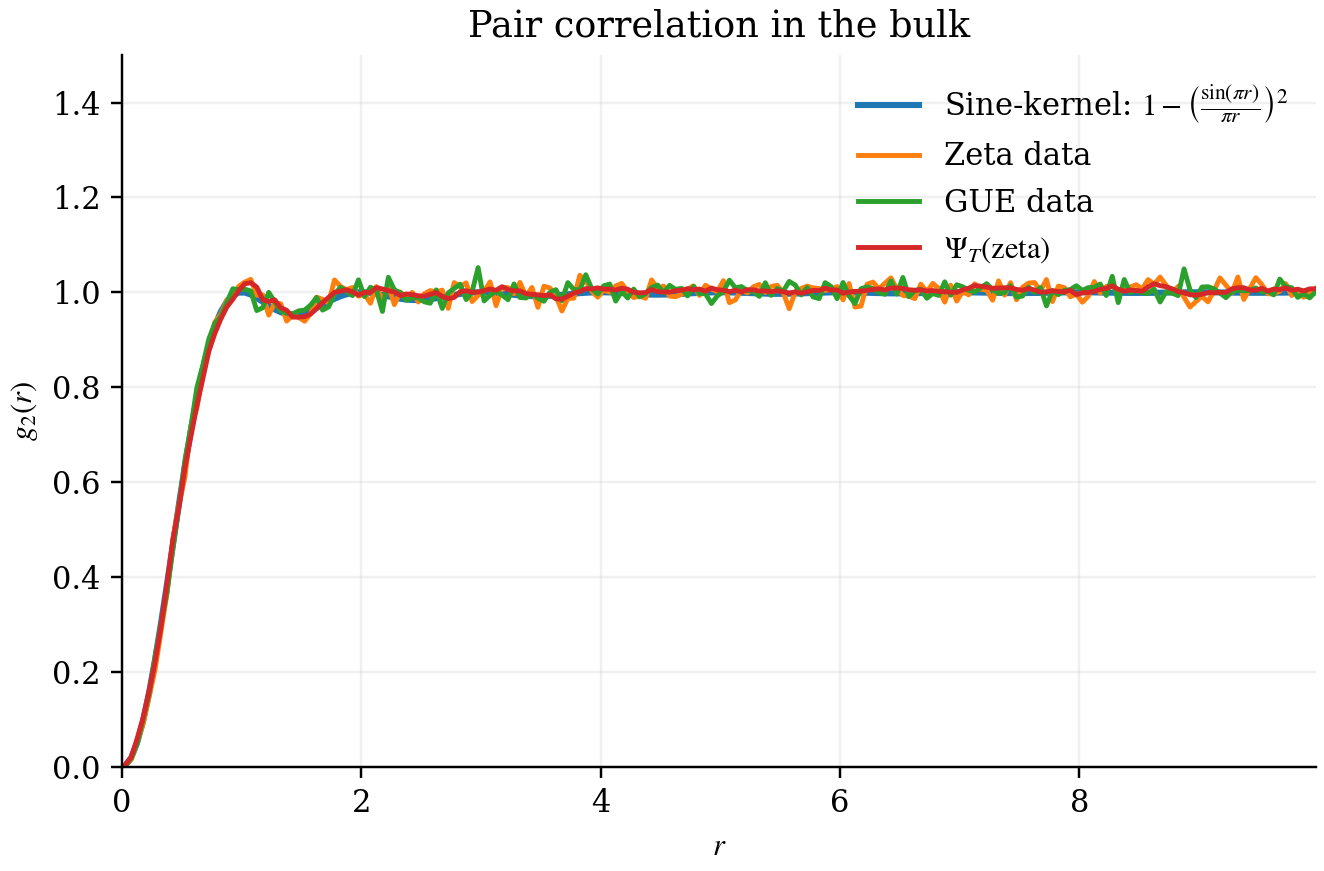
Training on Odlyzko's tables (\(1.5\) million zeros from \(\log T \in [12.7, \ldots, 14.4]\), plus high-zero computations near \(10^{12}\), \(10^{21}\), and \(10^{22}\)), the model learns the height-dependent structure. The sanity checks pass: gap distributions and pair correlations align across zeta data, GUE data, and flow-generated samples to within sampling noise.
The payoff is the height-indexed correction:
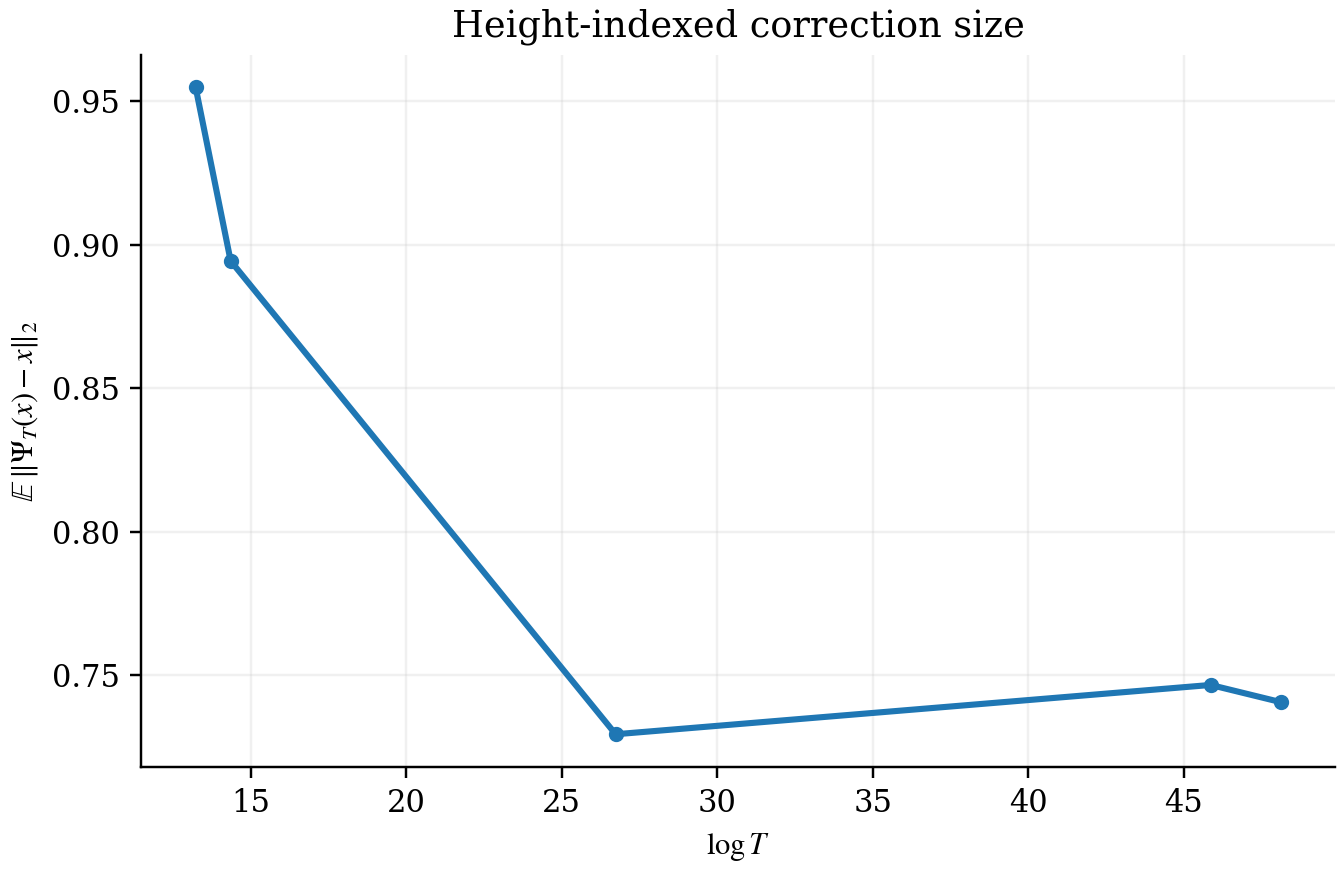
At low heights (\(\log T \approx 13\)), the mean \(L^2\) displacement is approximately \(0.96\). As we ascend to \(\log T \approx 27\), it drops to \(0.73\). The zeta zeros require progressively less correction to look like GUE eigenvalues (the slight uptick in displacement at extreme heights is an artifact of smaller sample sizes and model sparsity at those computational limits, rather than a theoretical divergence).
An earlier version of this exploration won me the 2024 CS 109 probability challenge at Stanford. It is a purely circumstantial proof that whatever mechanism generates the zeta zeros, it is relaxing toward the random matrix limit in precisely the way the hypothesis predicts.
In 2027, the year will be prime. In 2029, the year will be prime again. Twin primes: separated by two, the smallest gap possible for primes greater than two. We are, at the time of my writing this, living in the interval before a twin prime pair. The last twin prime years were 1997 and 1999. Anyone born then who is still alive has passed through exactly one such pair. Anyone born in 2027 will pass through theirs immediately, a birthright of chaos, and will not encounter another until 2081 and 2083, by which time they will be fifty-four years old and will perhaps have forgotten what it felt like to be born in a prime year, or will perhaps have never noticed.
I should tell you what is scheduled to happen during the upcoming pair.
On August 2, 2027, a total solar eclipse will pass directly over ancient Thebes, the Valley of the Kings, the tombs of the pharaohs. The sun will go dark at midday for six minutes and twenty-three seconds. This is the longest on accessible land until 2114. Hotels are already sold out.
On December 31, 2028, a total lunar eclipse will begin, and it will end on January 1, 2029. This is the first total lunar eclipse on New Year's Day in recorded history.
On April 13, 2029, asteroid Apophis will pass closer to Earth than our geostationary communications satellites. It will be visible to the naked eye for over two billion people. The asteroid is named after Apep, the Egyptian serpent god of chaos, the \(\widetilde{\mathfrak{Uncreator}}\), eternal enemy of Ra. April 13, 2029 is a Friday. Astronomers estimate that an asteroid this large coming this close occurs once every five to ten thousand years.
The pattern-seeking mind is hard to turn off. This is almost certainly apophenia, the same neural tic that finds faces in clouds and closets and constellations in scattered stars. I know the universe doesn't owe us narrative consistency, that coincidence is the null hypothesis and you need a reason to reject it, not a reason to keep it—in the same way that you need a reason to convict and not a reason to acquit, that the burden is on the prosecution, that the sane and sober and tenured thing to do when you see a pattern in the noise is to note it, \(777\) \(197\) \(971\) \(719\) file it away, and continue as before, and I have filed away a great many things and continued as before and generally found this to be a reliable policy.
Then again, the primes also have no business correlating with uranium nuclei to within the limits of numerical precision, and Montgomery had no business bumping into Dyson at tea, and Dyson had no business recognizing the formula on sight, and Odlyzko's ten billion zeros had no business lining up with a model built for an entirely different universe, and at some point the sober and tenured thing to do stops being to note the pattern and file it away and starts being to admit that you've been filing away the same thing over and over, that the folder is full, that the cabinet is full, that whatever it is you've been so responsibly ignoring has been patiently accumulating on your desk this whole time and is now taller than you are.
Nevertheless, in the first year of the twin prime pair: the sun goes dark over the tombs of the pharaohs, the longest in a century. In the second year: the Egyptian god of chaos arrives on Friday the 13th, closer than any large asteroid in recorded history.
The Unimaginable
Andre Weil described his research as "a love affair with the zeta function." Littlewood claimed to have become "infatuated" with the Riemann Hypothesis. Connes wrote that his framework awaits "the heroine" to complete it. Hardy wrote of "a mysterious attraction impossible to resist."Weil's phrase appears in his Oeuvres Scientifiques (1979). Littlewood's from his Miscellany (1953). Hardy's from A Mathematician's Apology (1940). Connes' from various interviews about his noncommutative geometry approach. The romantic register is unusual for mathematical writing. The word tantalizing appears constantly: "tantalizing connections," "tantalizing aspects," "tantalizing thoughts."
The dictionary definition of tantalize:
To tease or torment by exposing to view but keeping out of reach something that is much desired.
When I was seven I thought I invented a number. I was in the back seat of a Nissan with a coffee stain on the upholstery shaped like Italy, boot and all, even the little Sicily nub at the toe, and I'd been staring at it long enough that it had started to look like something else entirely (a dog, maybe), and before it could become anything else I started multiplying. I took 777 (a number I was obsessed with that year, for reasons I couldn't have articulated then and can only barely articulate now: something about the visual symmetry of it, the way it looked like a fence or because it29 meant53 your79 thoughts118 and19 creations104 can18 bring50 you61 closer72 to35 your79 dreams60, or because 777 was how old Lamech was when he died and then the world went back to water) and the Mephistophelian part of me multiplied it by 13, because 13 was the bad-luck number and I wanted to see what happened when you let it contaminate something pure.
I got it wrong several times. Working in the air, getting a different answer each time, and finally arriving, at 10101. The number was a palindrome. It read the same forwards and backwards. It had this quality of having been placed there, deliberately, at the other end of a multiplication I'd chosen on a whim. The number felt mine. Not found. Made. Of course anyone could multiply 777 by 13. Of course the palindrome was sitting there whether or not I ever reached it. I was treating a number the way you'd treat a stray cat that followed you home.
I didn't connect this to the dream until I was twenty, and even then connect is too strong a word for what happened. I had filed these memories on opposite ends of my life and it had never occurred to me to check whether the filing system was any good, which, it turns out, is the whole problem with filing systems: they work well enough that you never audit them, and by the time you do, the misclassification has been load-bearing for so long that correcting it rearranges everything. One was the nightmare of being beholden to something abstract, the other was the fantasy of owning it. Freud called this repetition compulsion. In Beyond the Pleasure Principle, he observed that people unconsciously restage unresolved conflicts, hoping that this time they will get it right and gain mastery over their situation.Written in 1920; Freud's primary evidence was traumatized soldiers involuntarily replaying battle scenes in their dreams.
Marie-Louise von Franz, the Jungian analyst, suggested that we have misunderstood the nature of number by treating it solely as a measure of quantity, a tool for the ego to order the world.From Number and Time: Reflections Leading Toward a Unification of Depth Psychology and Physics (1974). Von Franz argues that number archetypes underlie both psychic and physical reality, and that modern mathematics has amputated their qualitative, numinous aspect. She wrote of the qualitative aspects of number that appear in all ancient cultures but have been lost since mathematics bifurcated from number mysticism. Jung himself observed that the natural numbers seem to occupy a peculiar position in human cognition, neither purely invented nor purely discovered.Jung wrote about number archetypes primarily in his late letters and in Synchronicity: An Acausal Connecting Principle (1952), where he argued that the natural integers are archetypes of order that bridge psyche and matter. The primes, in this light, become something like the unconscious of arithmetic: the irreducible elements from which all else is built, yet which remain themselves ungovernable by the symbolic order they make possible.
Foucault had a name for that symbolic order: máthēsis (μάθησις), the governing episteme of the Enlightenment, the conviction that nature could be exhaustively rendered through measurement and table.
In his meditations, The Order of Things, Foucault identifies that every age organizes knowledge according to epistemes, deep structural principles invisible to itself.Published in France as Les Mots et les Choses (1966). An accidental bestseller, Parisians queued outside bookshops for a work of philosophical archaeology, which surprised everyone including Foucault. The Renaissance read the world as resemblances, the medieval mind saw divine text, and after the Enlightenment, we see quantity. That the integers themselves—the very instruments of mathesis—should harbor something opaque to their own methods is a peculiar irony. Indeed, every episteme is a cage, its bars welded from what it believes it knows.
What happens when, after three hundred years of holding up a particular image of mathesis—rational, autonomous, the measure of all things, the end in herself, sacred and inviolable—we finally look to the foundation and find it immaculate, except for one edge case, one thing we can't explain, and the thing we can't explain is what everything else is standing on?The reals are uncountable; the computable numbers are countable. Therefore, almost all real numbers cannot be specified by any finite procedure: no algorithm, no definition, no name.
Maybe we're due for the same Entzauberung visited upon our ancestors, our own kind of disenchantment, or maybe we've been living in it for a while and haven't noticed. It wouldn't be the first time; the whole point of an enchantment is that you can't tell you're under one, and the whole point of a disenchantment is that afterwards you can't believe you ever were. Though I suppose it's possible that knowing the name of the thing doesn't help you with the thing itself.
We built calculus on the integers, which is to say they built it on the primes, though nobody thought of it that way at the time, and on calculus we built thermodynamics, and on thermodynamics we built digital computers, and on digital computers we built differentiable programs that turned out to be able to recreate (or at least convincingly pantomime) the human language faculty, and we went to the moon, we did all of that, and the substrate under all of it, the part you'd assume we'd sorted out centuries ago, turns out to behave like the energy levels of a quantum system that no one has been able to find, a system that must exist (or so the correspondence implies) but that no one can name or write down or point to, and we've been building on it for three hundred years.
Gene Wolfe, on what it feels like to stand before such things:From The Shadow of the Torturer (1980), the first volume of The Book of the New Sun. This passage describes the Hierogrammates: beings from humanity's unimaginably distant future who have evolved beyond recognition and travel backward through time to guide (or manipulate) their ancestors.
every child is aware of them, blazing with glories dark or bright, wrapped in authority older than the universe. They are the stuff of our earliest dreams, as of our dying visions. Rightly we feel our lives guided by them, and rightly too we feel how little we matter to them, the builders of the unimaginable, the fighters of wars beyond the totality of existence.
The builders of the unimaginable. Yes.
When Riemann made his conjecture, he wrote that the problem deserved a rigorous proof. He was not being modest. He simply meant that mathematics requires proof, that conjecture is not enough, that we should not accept a statement as true merely because all the evidence supports it. Though here, we face a strange possibility: what if the structures and constructions inherent in a problem are so enigmatic that proof is not even the right relationship to have with them?
What the Berry-Keating correspondence implies is this: somewhere (in principle, perhaps in actuality) there exists a physical system. Its Hamiltonian has eigenvalues (energy levels) equal to the imaginary components of the non-trivial Riemann zeros. Its classical trajectories close with periods equal to \(\log 2\), \(\log 3\), \(\log 5\), \(\log 7\)… It breaks time-reversal symmetry. To find such a system, to build it, or show it must exist, would be one way of proving the Riemann hypothesis. \(\blacksquare\)
Dedicated to Armond Sosna.